Thursday, March 10, 2016

Sanders, Sandinistas, Clinton, and Contras in Context

I did not see the March 9 Democratic debate, but I have seen clips of the exchange Clinton and Sanders had over Sanders's support for the Sandinistas. 
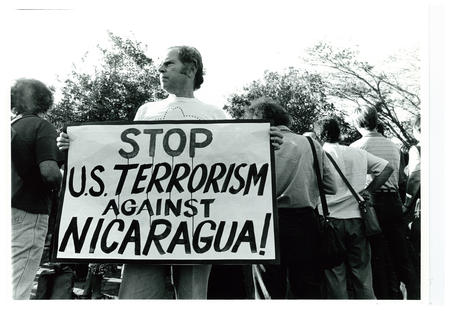
When I was an undergraduate, I spent a year researching and writing a ninety page thesis on Central American Solidarity activism--what Sanders is being maligned for participating in. As a result of this, I'd like to put Sander's activism in a historical context.
Between the Sandinista revolution and 1986 100,000 US citizens visited Nicaragua as part of solidarity activism.
One hundred thousand. 
That is a large number of U.S. citizens to visit any foreign country for politically motivated reasons. 
It is especially impressive considering they did so at great personal risk. In 1985, 29 activists with Witness for Peace were kidnapped by the Contras. In 1987, U.S. solidarity activist Benjamin Linder was murdered by the Contras--with the full support of the Reagan Regime in Washington. 
Fifty thousand Americas took a "Pledge of Resistance" to engage in civil disobedience should the Reagan Regime in Washington invade Nicaragua
Even if you don't want to extrapolate from the number of people who were willing to take great personal risks to oppose U.S. foreign policy in Nicaragua, opinion polls from the time show that Reagan's foreign policy in Central America was deeply unpopular--the most unpopular of any U.S. President up until that time. He received more letters to the White House about Central America than any other issue. 

Benjamin Linder (1959-1987) was a U.S. Central American solidarity
activist, who at the age of 27 was murdered by the U.S. back Contras.
And the Reagan Regime in Washington blamed Central American Solidarity activists, especially those who had traveled to the region, for the unpopularity of their wars, including the Contra war. A State Department official noted they were losing the war of information, because in every town in the U.S. small or large they visited there was someone giving a presentation about what they had first hand witnessed in Central America. The Regan Regime tried to counter this by setting up the The Office of Public Diplomacy for Latin America and the Caribbean, which devoted its full time to providing correct information about the region. It was shut down by the Government Accountability Office for being an illegal form of domestic propaganda, but not before booking 1,400 speaking engagements in 1,000 U.S. towns.
And why were so many people so concerned? 
The Contras were a terrorist organization. 
They deliberately targeted civilian infrastructure like health clinics and adult literacy centers. The Reagan Regime had the wonderful idea that since the Sandinistas's popularity rested in their promise of social programs that would improve the lives of poor people, if they violently eradicated those programs the Sandinistas wold be less popular! Oxfam called this the "fear of a good example."
The Contras also, in addition to being just general murderers, routinely engaged in rape and amputation of body parts against civilians in a systematic way in order to terrorize them into submission.
The Sandinistas, for whatever their faults, stood in democratic elections in 1984, elections which the UN and most Western European governments found to be fair, elections which the Contras, on the advice of the Reagan Regime, refused to participate in.
And how did the the Sandinistas lose power? 
They lost an election and left. 
Some dictatorship.
So in short, there are no words in the English language, or probably any other, to describe the pure visceral rage I feel for Clinton's attack on those who opposed the Contras.

Tuesday, February 16, 2016

Open Letter to Those Who Disagree With Scalia, but "Respect' his "Opinions"


 File:Justice Antonin Scalia Speaks with Staff at the U.S. Mission in Geneva (1).jpg


Hello Everyone,

I would just like to point out to all the people saying laudatory things about Scalia, on the whole liberal respect of other opinions grounds, that he wasn't just some guy with bad opinions--like a racist, but otherwise lovable uncle.

He was someone who was in an actual position of power over actual people's lives. How he wielded said power had tremendous consequences for actual people, like literally life or death consequences in things like decisions about the death penalty.

He used that power to try to make sure that torture was legal, to argue that there was no constitutional right not to be executed just because you were factually innocent, to uphold the right of states to jail LGBT people for consensual sexual acts, to overturn prohibitions on sex discrimination, and deny women the right to make decisions about their bodies.

This is not about respecting someone with whom you disagree, this about resenting the actual damage that the reprehensible actions of a person did.

It isn't zany, but admirable when someone argues there is nothing to prohibit states from flogging people or amputating ears when said person has the actual power to determine whether such a thing does or does not happen.

So no, no one has to respect his brilliance (which is questionable anyways, since in spite of the fact that he was a talented writer if anyone who was not a Supreme Court justice uttered some of his beliefs they almost certainly would be considered unserious or ludicrous, not a gifted purveyor of legal reasoning, by the same people singing his praise. This is to say nothing of the fact that he spent much of his time pondering why Satan had stopped tossing goats off of cliffs), when said brilliance was used for evil.

His actions had consequences for millions of people, I don't see why he shouldn't be one of them.

Monday, February 15, 2016

Hillary Clinton's "Experience" is Largely a Vapid, Politically Meaningless Argument

As Bernie Sanders has risen in the polls and had an unexpected degree of success in Iowa and New Hampshire, thus posing a potential problem for Hillary Clinton’s coronations, it has been immensely enjoyable watching the Clinton campaign and its many co-conspirators panic. This has ranged from the very bizarre, such as comparing the demand of tuition free college, something that was in the past accomplished in both California and New York City (to say nothing other many countries where it is still a reality) to the redistribution of ponies, to the really rather shameless, like the number of professional pundits attacking Sanders support of single payer, when they themselves supported single payer until it became politically pragmatic to attack Sanders.

What is most remarkable about all of this, is that even though those leading the attack on Sanders purport to be the guardians of all things very serious against Sanders and his supporters unrestrained un-seriousness, is that the arguments that Clinton supporters have resorted to are almost all extremely vapid. That is, while they have taken the most condescending of attitudes towards Sanders supporters, instructing them that support for Sanders is unacceptable given that his policy proposals are unrealistic, vague, short of specifics, etc., they have been relentless in trotting out arguments that are completely hollow, devoid of any underlying political content, and ultimately meaningless.

 Nowhere is this more on display then the fixation on Hillary Clinton’s experience. In case you have not recently been evangelized to on this point, not only is Clinton more “experienced” than Sanders, she is the most experienced candidate for President. Ever. Objectively so! Ignoring how one reaches the “objective” conclusion that Clinton is the most experienced candidate for President ever or that her sum time in public office consists of nine years as a Senator and six years as a Secretary of State and Sanders time in public office consists of eight years a mayor, 26 years as Representative, and nine years as a Senator, let’s examine this argument.

On its face it appears valid. After all, it is generally taken for granted that having experience for a “job” is a good thing. However, it is also important to take into account experience doing what. And more importantly, it is worth asking how one plans on using that experience.

Yet, that is precisely the opposite of what those relying on the experience argument do. There may be some vague comments about Clinton’s past positions, followed by how this will enable her to achieve the change we need. Essentially Clinton did stuff, and will continue to do stuff. Why “the stuff” part is usually so vague is a familiar story at this point. Clinton’s record of support for destroying welfare, supporting “tough on crime” policies, and aggressive wars is relatively inconvenient at this juncture in history when many potential Democratic primary voters are angered by income inequality and the vanishing Welfare State, racism and its relationship to the criminal justice system, and war. It is hard to see how said experience can be considered an asset, unless Clinton and company are claiming that after all these years she has experience, as what not to do. There is also the problem of what she will accomplish more generally. While Clinton and her supporters tout her proposals as being realistic alternatives to Sanders utopian dreaming, it is doubtful that very many people believe even if she did have a magic wand she would use it to achieve single payer healthcare. Clinton is not merely more realistic than Sanders and thus is proposing only policies she knows can be accomplished,; Clinton is fundamentally philosophically opposed to the type of social democratic project that Sanders is committed to. All of this is masked by an appeal that a general experience devoid of political content will equip her with a general competency devoid of political content.
Nowhere is this lack of politics more stunningly on display then in an exchange on Henry Kissinger that took place during a February 12, 2016 debate on Democracy Now! between Jeffery Sachs and Rep. Gregory Meeks. This came on the tail of Sanders eviscerating Clinton’s touting of Henry Kissinger’s support of her. Rep. Meeks defended Clinton’s Kissinger connection on the grounds that he talks to people with “expertise” regardless of their disagreements. He stated, “even if it’s a different party, you talk to your former colleagues to find out what they did and how they did it.”

This is all fine and dandy and has a ring of truth around it in an extremely generalized sense. Yet, when the position involves foreign policy you may want to rethink talking to someone who is unable to travel to many countries do to the fact that he is wanted for questioning pertaining to war crimes. Rep. Meeks is particularly exemplary of this phenomenon of giving answers devoid of political content. He ignores the fact that being Secretary of State isn’t just another job, it is an inherently political one, and thus getting advice from other individuals isn’t like how to figure a complex accounting problem or other technical task.

Yet, for those arguing in favor of Clinton have rendered not just being a Secretary of State into a rote, technical task, but the presidency, as well. It does not matter that Clinton supported the War in Iraq or the destruction of welfare, the presidency is merely a technocratic job for which these past experiences have left Clinton well-groomed.

Allowing an actual debate over politics to enter the mix here is doubly frightening for Clinton and those who defend her. First, her actual political choices appear very unsavory compared to Sanders’. However, there is something far more dangerous. The Clintons and much of the punditry assume that certain realms of policy are immune from serious political debate, that certain political criticisms are so far out of the framework of a bipartisan consensus that all serious people share they cannot even be considered. This is why a Democratic Senator can (and must) support a Republican initiated war. In fact, Bill Clinton’s policies towards Iraq, which included not just sanctions, but an explicit policy of regime change and regular bombing campaigns certainly paved for Bush’s escalation of U.S.-Iraq policy in the form of a full-scale invasion and occupation. This is why many of the figures responsible for implementing the Clinton-era policy supported, at least early on, Bush’s own policies. The same is true of a general consensus that serious people want to privatize or eviscerate swaths of the welfare state and only unserious people feel otherwise.

Once this technocratic worldview of U.S. policy is dropped, and actual policy comes back into the picture, the appeals to experience, expertise, ability to accomplish unspecified things all starts to appear pretty vapid. It is then becomes Clinton, not Sanders, whose campaign is short on meaningful specifics.

Wednesday, September 25, 2013

Tell Me Why It Is We Vote For Democrats Again?

Journalist Jeremy Scahill commented on today's Democracy Now! that Obama's United Nations speech was "really naked sort of declaration of imperialism[...]" I couldn't help but notice that President was really just echoing his progressive predecessor Jimmy Carter. And not in a good way.
The region which is now threatened by Soviet troops in Afghanistan is of great strategic importance: It contains more than two-thirds of the world's exportable oil. The Soviet effort to dominate Afghanistan has brought Soviet military forces to within 300 miles of the Indian Ocean and close to the Straits of Hormuz, a waterway through which most of the world's oil must flow. The Soviet Union is now attempting to consolidate a strategic position, therefore, that poses a grave threat to the free movement of Middle East oil.
This situation demands careful thought, steady nerves, and resolute action, not only for this year but for many years to come. It demands collective efforts to meet this new threat to security in the Persian Gulf and in Southwest Asia. It demands the participation of all those who rely on oil from the Middle East and who are concerned with global peace and stability. And it demands consultation and close cooperation with countries in the area which might be threatened.
Meeting this challenge will take national will, diplomatic and political wisdom, economic sacrifice, and, of course, military capability. We must call on the best that is in us to preserve the security of this crucial region.
Let our position be absolutely clear: An attempt by any outside force to gain control of the Persian Gulf region will be regarded as an assault on the vital interests of the United States of America, and such an assault will be repelled by any means necessary, including military force.-- President Jimmy Carter 1980 State of The Union Address


The United States of America is prepared to use all elements of our power, including military force, to secure our core interests in the region. We will confront external aggression against our allies and partners, as we did in the Gulf War. We will ensure the free flow of energy from the region to the world.--President Barack Obama 2013 United Nations General Assembly Address. 
Someone needs to quickly explain to me again about the lesser of two evils or else I might come to hold the heretical belief that both parties's leadership is committed to an imperialist foreign policy for the United States. 


Wednesday, July 31, 2013

Bradley Manning is a Prisoner of Conscience

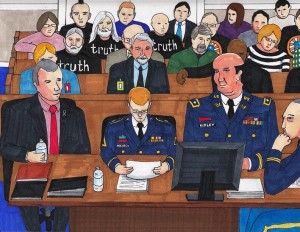
One of the most disgraceful elements of the corporate media’s campaign against whistleblower Bradley Manning has been the constant attempts at character assassination. The corporate media, when they cover Manning, constantly need to obsesses over gossipy details of Manning’s personal life. While that may be the grade of material tabloids thrive on it has nothing to do with Manning’s extraordinary act of conscience that will land him in prison for possibly the rest of his life.

    PBS’s Frontline* despicable episode on Bradley Manning is an excellent example of this. It gives extensive coverage of Manning’s personal life, which very well may have been slightly troubled (I imagine most of the readers of this have experienced troubled times during their life) and gives almost no consideration of possible political, moral, or ethical reasons for why Manning did what he did. The point of this media narrative is to diminish the rational behind Manning’s act. Manning leaked classified information, because he was a mentally unstable individual, a misfit, and a malcontent. Exposing war crimes at risk to one’s personal liberty is not a profound moral act exhibiting the best in human behavior, it is an anti-social act carried out by a disturbed individual looking for attention or an artificial sense of belonging.

    However, we know from Manning’s own words, both from the chat logs that led to his persecution and his statement in court what motivated him. He makes it very clear that his political consciousness developed through routinely watching the dehumanization of the Iraqi people and the senseless violence against them it allowed.

    Manning told Adrian Lamo, who assured Manning that as a “journalist and minister” Manning’s “confession or interview” would “enjoy a modicum of legal protection,” that “the thing that got me the most… that made me rethink the world more than anything” was


watching 15 detainees taken by the Iraqi Federal Police… for printing “anti-Iraqi literature”… the iraqi federal police wouldn’t cooperate with US forces, so i was instructed to investigate the matter, find out who the “bad guys” were, and how significant this was for the FPs… it turned out, they had printed a scholarly critique against PM Maliki… i had an interpreter read it for me… and when i found out that it was a benign political critique titled “Where did the money go?” and following the corruption trail within the PM’s cabinet… i immediately took that information and *ran* to the officer to explain what was going on… he didn’t want to hear any of it… he told me to shut up and explain how we could assist the FPs in finding *MORE* detainees…

During his opening statement at Manning’s court martial his defense attorney David Coombs  recalled a story that illustrates Manning’s deep moral convictions. On Christmas Eve a roadside bomb went off. It was meant to target a US convey, but missed. Instead it killed an Iraqi civilian. Manning’s fellow troops went onto celebrate the escape, but according to Coombs Manning “couldn’t celebrate...He couldn’t forget about the life that was lost on that day. He couldn’t forget about the family lost on that Christmas Eve.”

    Manning suffered from the problem that he believed Iraqi lives were equal to American ones and that the loss of Iraqi life, the torture of the Iraqi people were grave moral wrongs. Moral wrongs that he wanted to right. This is what motivated Manning to become a whistleblower. As his lawyer explained, “When he decided to release this information, he believed this information showed how we value human life. He was troubled by it and he believed if the American public saw it they too would be troubled by it and maybe things might change”

    Or as Manning said in his own words at his trial

 
“I believe that if the general public, especially the American public, had access to the information contained within the CIDNE-I [Iraq War Diaries] and CIDNE-A [Afghanistan War Diaries] tables this could spark a domestic debate on the role of the military and our foreign policy in general as [missed word] as it related to Iraq and Afghanistan”


He stated that he believed by his actions he was “removing the fog of war and revealing the true nature of twenty-first century asymmetric warfare.” Daniel Ellsberg, possibly America’s most famous whistleblower, said at a Free Bradley Manning rally that asymmetric wars are wars that are
“the strong against the weak. What used to be called colonial wars. Wars asymmetric because one side has planes, helicopters, drones, napalm, artillery, tanks, and the other side has none of that--only suicide bombers if they’re fighting and IEDs--improvised explosive devices--so it’s asymmetric. And the result of that is the great slaughter of innocence which a war crime..”

    Mannning’s detractors have often pointed out that he not only leaked information detailing rampant violence in Iraq and Afghanistan, but diplomatic cables--thus proving that Manning is not a whistleblower, but an irresponsible attention seeker who dumped a large amount of information without forethought. However, Manning explained these actions to Lamo very lucidly as well. He stated that he had access to “crazy, almost criminal political backdealings ... the non-PR-versions of world events and crises” and that he believed the  diplomatic cables demonstrated “how first-world countries exploited third-world countries.” While much brouhaha has made over the sanctity of diplomacy and the importance of secrecy in carrying it out when one sees that the cables reveal things such  as how the most powerful country on Earth used its diplomats to try to bully one of the poorest countries in the world (Haiti) into not raising its minimum wage at the bequest of a private corporation it becomes very clear how the “first world” exploits the “third world.”

    What emerges here is a clear pattern. Manning’s actions and motivations are not that of a troubled individual, a misfit, or a malcontent, but someone who saw great crimes being committed, crimes that shocked his conscience. He believed that if the American public saw these crimes they too would be shocked, that they would make sure that they did not continue in their name.

    Sadly, this was not the case. The corporate media with its self-appointed role as gatekeepers of information has always censored and kept from the public at large the senseless violence implicit in US wars. It has also now marginalized Manning for failing to be what Prof. Cornel West has for years refereed to as “well adjusted to
  
injustice.”  It is because Manning refused to be “well adjusted to injustice,” that he saw slaughter and corruption and decided to follow his conscience to stop it that he is now imprisoned most likely for the rest of  his life.
 
  Bradley Manning is a prisoner of conscience. But we must not rest. We must not only continue to demand his freedom, to demand that those who commit war crimes be prosecuted, not those who blow the whistle on them, but we must also demand an end the senseless dehumanization of foreign people that allows our government to murder and exploit them.

*Certainly not the “corporate media” in a technical sense but this particular piece is most illustrative of a wider trend.

Tuesday, July 30, 2013

Manning Verdict In

After just a few hours my previous blog post on the ramifications of the worst potential outcome of the Manning trial is already outdated. And I can't say I am sorry as it means Manning was found not guilty of the most serious charge against him--aiding the enemy. He was also not found guilty of charges under the Espionage Act for his release of the collateral muder video.

 
 The Collateral Murder Video

However, today was not an overwhelming victory for Manning. In addition to the charges he pleaded guilty to earlier this year he was convicted of 19 counts, including violations of the draconian Espionage Act which was created during World War I and used at that time largely to criminalize the anti-war movement. Together, these charges means Manning could face up to 154 years in prison. The graphic below breaks down the charges, Manning's pleas, and the verdict.

From https://twitter.com/carwinb/status/362268687522209792/photo/1

 As someone who has followed this story from when the Collateral Murder video was first posted online, through Manning's torture and pretrial punishment, and finally the trial itself I have very mixed emotions about today. I am glad the worst that could have happened did not happen. Still, I am very disgusted that any whistleblower should be persecuted under the color of law while war criminals go free. As I take time to decompress what happened, I will be writing more about my thoughts on the verdict, Manning, the war on whistleblowers, and the unsavory history  of the Espionage Act.

What’s At Stake With Bradley Manning’s Verdict

In a matter of hours the military will decide whether Bradley Manning is guilty of aiding the enemy, amongst other charges. The corporate media has done a remarkably poor job of covering Manning’s trial (those outlets that have covered it all) so what is at stake in tomorrow’s verdict has been relatively obscured.
  
 I am certainly willing to debate anybody about whether Manning is a whistleblower and as a result deserves protection under the law not persecution under it, but that is ultimately not the issue of today’s verdict. Manning has already pled guilty to leaking classified information and will be serving 20 years in a military prison.  Even the most ultra-orthodox authoritarian should be satisfied since the absolute importance of maintaining the secrecy of information deemed secret by the government even if said information details criminal activity has been upheld. End of story.
  
 Instead Manning is being charged with the lunatic charge of “aiding the enemy.” Aiding the enemy not only carries life imprisonment, a truly sickening thought in this case, but it has serious ramifications for freedom of speech, freedom of press, and whistleblowers everywhere.
   
Manning did not seek to give information to a hostile terrorist organization or state in hopes of furthering their military campaigns against the United States. He did not leak troop positions, military strategies, and his leak has in no way endangered US lives or military actions. Instead, it embarrassed the government, documented violence against civilians in Iraq and Afghanistan, and exposed war crimes.
   
The argument is that because he put this information in the public domain bin Laden or other evil doers can access it. Because bin Laden has a lab top he can access Wikileaks or the New York Times and read about how the most powerful country on Earth used its diplomats to try to bully one of the poorest countries in the world (Haiti) into not raising its minimum wage at the bequest of a private corporation. He could learn that the United States keeps a causality count in Iraq or that they have found new ways of making sure Iraqis they don’t like are being tortured in a way that allows the US not to actually get its own hands dirty. None of this information helps the hypothetical evil doer in anyway really other than maybe confirming their preconceived biases against the United States or giving them new ideological capital. But if that’s the case should all wrongdoing or unflattering information about the United States should be hidden in case it might make people do bad things? Doesn’t it also have the power to inspire the American people to stand up and take charge of the government which is carrying out these distasteful policies in their name? To use their democratic process to say “Enough is Enough?”
  
 Harvard Law Professor Yochai Benkler,testifying for the defense during a hearing to dismiss the aiding the enemy charge, stated that if Manning can be found guilty of aiding the enemy so can any of media outlet publishing the information online (like The New York Times).
 
  The question is where is the line become drawn? If I read a New York Times article that has potentially embarrassing information about the United States government’s foreign policy and discuss it with a friend at a Starbucks should I be concerned than if an unknown evil doer is listening that I may be aiding the enemy? Should I be afraid to write about the case against Manning on my blog or mentioning information that I learned from its coverage in the New York Times, NPR, PBS, CNN, etc? After all, there is no device on blogger to block evil doers from reading this blog.
  
 And why stop just at foreign policy or even classified information? Don’t people who point out the buffoonery of the Tea Party Republicans in Congress embarrass the American government and make it appear weak and inept? Is that aiding the enemy?
  
 Of course, this nightmare totalitarian situation, while a logical extension of the case against Manning, is never going to happen. The New York Times will not be shut down and its editorial board will not be imprisoned. No one will be dragged out of Starbucks unable to finish their latte for discussing today’s headlines on NPR. However, this extension of what it means to aid the enemy will be used selectively and its victims will be those who oppose the policies of endless warfare and corporate domination. And that’s ultimately what this trial is about. If it was merely about protecting classified information the government would have quit when Manning pled guilty to essentially leaking classified information. Instead, they have forged ahead with this insane charge in hopes of fashioning a new tool to be used to intimated whistleblowers, journalists, and any dissidents who oppose global empire and neoliberal capitalism.
  
 As a result, we should be viewing this case not through the prism of whether Manning leaked classified information, but through the prism of one of the most important freedom of speech and freedom of press cases in decades. It is important that everyone understand what is at stake.

Saturday, June 29, 2013

"Pepper Spray, Rubber Bullets, and IRS Questionares"

Earlier this week Truth Out published an original article of mine. It's entitled "Pepper Spray, Rubber Bullets, and IRS Questionnaire" and deals with a very peculiar trend that I've noted in the American corporate media. As I write in my piece,

Pepper spray, rubber bullets or an IRS questionnaire - which of these poses the greatest threat to your political speech? If the recent brouhaha over the IRS's singling out of Tea Party groups and the lack of a similar uproar over the systematic use of state violence against the Occupy movement is any indication, only the IRS questionnaire poses any threat to our democracy. It may seem rather bizarre, but in our current political and media climate, Karl Rove and his well-monied friends are potential victims of a nefarious political police and Occupiers are just a public nuisance.
The full piece can be read here. Additionally, Popular Resistance, a new website that seeks to provide daily news about the grassroots movements that challenge corporate hegemony, has reprinted it. 

Saturday, June 1, 2013

Why I Am Marching For Bradley Manning


"I start from the supposition that the world is topsy turvy. That things are all wrong. That the wrong people are in jail, and the wrong people are out of jail. That the wrong people are in power, and the wrong people are out of power. I start with the supposition that we don't have to say too much about this because all we have to do is think about the state of the world today and realize that things are all upside down." --Howard Zinn

Bradley Manning, the whistleblower responsible for the trove of Iraq, Afghan War and diplomatic cables released by Wikileaks, is scheduled to stand trial beginning on June 3. This weekend at Ft. Meade there will be a protest before his trial calling for Manning’s release (For more info check out this site). I plan on attending and have outlined a few reasons why I personally am committed to freeing Bradley Manning

1. Bradley Manning has been tortured.

While Bradley Manning has pled guilty to some of the charges against him, he has not yet been tried and has been in custody since May 2010, meaning that he has been held for three years without a trial. The military judge ruled that part of his time in custody was an illegal form of pretrial punishment and has credited any future sentence Manning would receive with 112 days time served.
Even more disturbing than the fact that the treatment Manning endured was pretrial punishment is that the United Nations Special Rapporteur on Torture found that his treatment during this time constituted “cruel, degrading, and inhuman treatment.”  / Manning was kept in an extreme form of solitary confinement during which he was confined to a windowless 6 x 12 ft cell for 23 hour day. The conditions were worse than those experienced by American citizens on death row.  
2. The Charges Against Bradley Manning Are Not Only Baseless, but Dangerous
As mentioned earlier Manning has pleaded guilty to ten of the charges against him. Amongst the charges he has not pleaded guilty to include the count of “aiding and abetting the enemy.” This charge is very serious, as it carried the possibility of death sentence (although the prosecution is not seeking the death penalty Manning would still receive life without parole if convicted). It also undermines any notion of democracy as it essentially criminalizes whisteblowing, journalism, and even dissent. Manning is not accused of giving secrets to a hostile foreign state or terrorist organization. Instead, he is accused of leaking information to the whistleblowers website Wikileaks, which in turn turned over such information to newspapers, such as the New York Times and the Guardian.
At first glance, it is unclear who the government considers the  enemy to be. Is it Wikileaks? The New York Times? Or we the American people? However, the prosecutor's argument is that by placing information in the public domain through such sources as Wikileaks and the New York Times “the enemy,” which includes al-Qaeda, was able to access it.
If this was a work of fiction, perhaps something from the cannon of Franz Kafka, this charge would be comical. However, its implications are deeply disturbing and essentially criminalize all whistleblowing and even journalism since any information in the public domain, on the internet, or in newspapers can potentially be accessed by the “enemy.”
Furthermore, no US lives have been endangered by Manning’s action and he revealed no military intelligence or battle plans. It is unclear why al-Qaeda would feel aided by knowing that the American occupation forces in Iraq had a policy of ignoring complaints of torture or that American diplomats conspired with American corporations in actively pressuring the Haitian government against raising the minimum wage. This is unless the American government believes that any information exposing corruption or unflattering actions on their part aids groups engaged in violence against the American people and the American government. This too has deeply disturbing implications. If carried to its logical extreme once again it would de facto criminalize any whistle blowing or even any dissent as “aiding the enemy.”
Luckily, the military judge has rejected the prosecutor's theory of what it means to aid the enemy and instead ruled that the government must prove that Manning acted ““with reason to believe such info could be used to the injury of the US or to advantage of any foreign nation.”
This is certainly is an improvement over what the prosecution wanted, but it still is a threat to whistleblowers everywhere to try Manning for aiding the enemy, particularly when he has already pled guilty to leaking classified information. Furthermore, Manning is a whistleblower and should not be facing any criminal prosecutions. 

3. Manning’s Whistleblowing was a Contributing Factor for the Arab Spring and the US Withdrawal From Iraq .
It is hard to determine what role a single event ever plays in the course of human history. There is also no question that oppostion to corrupt US-backed dictators in Egypt and Tunisia, as well as opposition to the occupation of Iraq long predated Manning’s actions. However, while we do not know what would have happened had Manning not leaked information documenting extreme corruption amongst US client states or the Arab world or the Collateral Murder video such releases helped to spur both the Arab Spring and the eventual US withdrawal from Iraq.

4. NO ONE HAS BEEN JAILED FOR REAL CRIMES

To this day not a single American official has been charged with any crime relating to the murderous, brutal, illegal, and quite frankly evil invasions and occupations of Iraq and Afghanistan. None of the key architects of the post 9/11 policies of torture have ever faced any criminal sanctions. Obama, to this day, continues to assassinate people via drone strikes, including a 15 year-old American citizen accused of no crimes or links to terrorism (Robert Gibbs suggested his death was his own fault though he not having picked a better father). Decades of support for Israel’s brutal policies of apartheid, colonization, and occupation and for Latin American oligarchs, death squads, and coups have similarly warranted no formal legal sanctions. Yet, Manning stands accused of essentially revealing to the American people the corrupt acts of their government and he has punished without being tried, tortured, and now stands to potentially be imprisoned for life. Clearly the world is topsy turvy. 

Monday, December 10, 2012

Bourgeois Economist Meet Marx, Marx Meet Bourgeois Economist

A specter is haunting the bourgeois economists, the specter of Marx. Paul Krugman opining today in The New York Times joins the growing ranks of mainstream economist who are wondering in light of the recent economic collapse that maybe a certain bearded German theorist was not totally wrong. Mostly wrong, but not completely. Will they come all the way around? Will we be seeing members of the Wall Street Journal editorial board against the barricades screaming, "Bourgeois economist of the world unite you have noting to lose but your chains!" Most likely not (though stranger things have and will happen). Nonetheless the quotes listed below are inexplicably satisfying.
‎"The only guy who really called this right was Karl Marx. Marx understood what would happen if you let the market run amok"--Jim Cramer in an interview with Time Magazine

"Karl Marx had it right.  At some point, Capitalism can destroy itself.  You cannot keep on shifting income from labor to Capital without having an excess capacity and a lack of aggregate demand.  That's what has happened.  We thought that markets worked.  They're not working.  The individual can be rational.  The firm, to survive and thrive, can push labor costs more and more down, but labor costs are someone else's income and consumption.  That's why it's a self-destructive process."--Nouriel Roubini in an interview with the Wall Street Journal 

"Does Capitalism Need to Be More Marxist to Survive?"--Paul Gambles Managing Partner, MBMG International writing for CNBC

"Wait — are we really back to talking about capital versus labor? Isn’t that an old-fashioned, almost Marxist sort of discussion, out of date in our modern information economy? Well, that’s what many people thought; for the past generation discussions of inequality have focused overwhelmingly not on capital versus labor but on distributional issues between workers, either on the gap between more- and less-educated workers or on the soaring incomes of a handful of superstars in finance and other fields. But that may be yesterday’s story.

More specifically, while it’s true that the finance guys are still making out like bandits — in part because, as we now know, some of them actually are bandits — the wage gap between workers with a college education and those without, which grew a lot in the 1980s and early 1990s, hasn’t changed much since then. Indeed, recent college graduates had stagnant incomes even before the financial crisis struck. Increasingly, profits have been rising at the expense of workers in general, including workers with the skills that were supposed to lead to success in today’s economy."--Paul Kraugman writing in the New York Times

Tuesday, November 20, 2012

New Piece on Israel's Bombing of Gaza


I have a new op-ed published on Speakout at Truthout. It’s about Israel’s bombing of Gaza and how it rests on the dehumanization of the Palestniain people. It can be viewed here, but here is a brief teaser--

In light of Israel’s bombing of Gaza, we can arrive at one conclusion: in order to support it one must show a complete and total disregard for the lives of Palestinians, or at the very least believe them to be worth less than that of their Israeli counterparts. Proponents of the bombing, including the Israeli government, maintain that they are merely defending human life from the unacceptable assault of the rockets. Yet, their own actions in just a few weeks have already taken far more human lives than the rockets have in over a decade. Even more jarring is the topsy-turvy world the Israeli government and their supporters seem to inhabit. In this world aggression is labeled defense and the narrative used to justify said inversions bares little relation to realty. No mention is made of what precipitated the latest round of violence nor is any mention made of the larger context--decades long policies of oppression directed towards the Palestinian people. None of this matters since after all the Palestinians don’t seem to matter.

Monday, November 19, 2012

The New York Times--Still Anti-Palestinian Even when "Critiquing" Israeli Policy


The New York Times criticized Israel’s latest violence, but only because it doesn’t seem to be an “effective way of advancing its long-term interests” and may “divert attention from what Prime Minister Benjamin Netanyahu has repeatedly described as Israel’s biggest security threat: Iran’s nuclear program.” Israel’s actions are wrong not because they kill Palestinian civilians or violate international law, but because they might not advance Israel’s interest or get in the way of saber-rattling with Iran. Such an inability to assess Israel’s action from any other framework than Israel’s “interests” shows a callous indifference to the suffering of the Palestinian.   
This apathy should not be surprising. The only justification for Israel’s policies towards the Palestinian people, which include not only the latest round of aggression, but the expulsion of refugees, the refusal of their universally recognized legal right to return for the sole reason that they are Palestinian, the constant colonizing of land in the West Bank, can only rest on the dehumanization of the Palestinian people. The latest round of aggression is no exception

Saturday, November 10, 2012

Truth-Out

.Truth-Out recently published an original op-ed by me on the subject of Occupy Wall Street and the Prison-Industrial Complex. The complete piece can be found here, but here is preview of what I wrote:

Since Occupy first exploded onto the scene, many within the political establishment and mainstream media have criticized occupiers alternatively for a lack of demands and for embracing too many seemingly unrelated demands. In spite of this confusion among those who are the self-appointed gatekeepers of political discourse, most people have understood Occupy as being a movement concerned with corporate influence over government, economic inequality and the economic crisis at large. It is precisely for those reasons that Occupy should be concerned about America's penal population (which is not to say that many Occupy groups and occupiers are not).
The current regime of mass incarceration is very much tied to the emergence of the neoliberal state in America. The neoliberal state demands stability for the market, but ultimately generates instability with its generation of surplus populations and lack of social resources. This means that while neoliberalism seeks to limit state intervention in the market and slash social welfare nets in the name of "freedom," it inevitably results in increased coercion, militarization and incarceration. And with its desire to subject every aspect of society to the market, prisons become not just a necessity under neoliberalism, but a profitable venture. These factors, not an epidemic of criminality, are the chief causes of mass incarceration in America. Prisons are therefore very much tied to the larger economic polices that Occupy opposes.

Thursday, October 25, 2012

Affirmative Action Isn’t Discrimination


Earlier this month the Supreme Court once again took up the issue of affirmative-action. Many who have not closely followed the bizarre, soap opera saga that is the Supreme Court and affirmative action may be surprised to know that the Supreme Court is only willing to accept as constitutional affirmative action regimes that cite “diversity” as their raison d'être. This is because in the original Supreme Court decision on the subject four members of the court ruled that affirmative action was unconstitutional and four ruled that affirmative action as it is popularly understood (as a program to address racial injustice) was not. To overcome this stalemate Justice Powell concurred and dissented in part with both factions. He decided that affirmative action meant to address racial injustice was in fact unconstitutional, but it could be constitutional if the program was meant to ensure “diversity.” Of course this meant as liberal thinker Elizabeth Anderson pointed out that affirmative action as it is currently practiced is “divorced from the aims of social justice.” See Elizabeth Anderson. The Imperative of Integration. Princeton, N.J: Princeton University Press, 2010. Pg. 142.

The Supreme Court is constitutionally incapable (pun intended? maybe...) of dealing with structural racism. However, much of the public discourse surrounding affirmative action (including that which is in response to the recent Supreme Court hearing) deals mostly with the traditional issues of racial injustice that affirmative action was designed to address. Because I am merely writing a humble blog and not arguing before the Supreme Court or structuring an affirmative action program for a major university, I am going to ignore the bizarro world of the Court and an actual argument against affirmative action that I frequently hear parroted. 

One of the most common criticisms I hear against affirmative action, including from liberals, is that affirmative action is racial discrimination and racial discrimination is wrong. As Justice Roberts opined  “The way to stop discriminating on the basis of race is to stop discriminating on the basis of race.” Clearly the sort of insightful legal analysis becoming only of the presiding member of America’s highest court. 

However, people who had advance this claim neglect an important point. Affirmative action isn’t racial discrimination. Racial discrimination happens when affirmative action is not in place. Racial discrimination happens when disproportionately fewer numbers of minority students are admitted into higher educational institutions. When a program is put in place and the demographic make-up of those admitted reflect society at large that is not discrimination, but a counter to actual racial discrimination. 

I would even be willing to concede for the sake of argument that reverse discrimination is in itself a form of discrimination and is thus deplorable. These arguments are fallacious when applied to affirmative action because they fail to understand the nature of affirmative action. While it would be nice to live in a “colorblind” society the simple fact is that Americans do not. If such, widespread, institutional discrimination (check out our prison system for proof of that) exists shouldn’t society at large take it into account? 
If so called “race neutral” or color blind college admissions were really race neutral admissions would reflect the racial make-up of our society. They do not because we do not live in the colorblind society opponents of affirmative action imagine.  Ignoring this fact will not help us to achieve such a society, but instead it will just help to perpetuate widespread, systemic institutional racism. Eliminating affirmative action does not create a “colorblind” admissions process. The argument of reverse discrimination made by opponents taken at face value may appear logical, but they are merely sophisms.

Wednesday, October 24, 2012

Mitt Romney--Mouthpiece for Assad?


      I am not one of those “leftist” who in the name of anti-imperialism embraces whatever dictator the US or its cronies currently has in its sights and turns a blind eye to his crimes against his own people. I am also not one of those who has illusions about American foreign policy having any humanitarian impulses (Long time readers of this blog will recall my first post was a detailed assault on the very notion of “humanitarian intervention”). Unlike some of my comrades I see nothing contradictory between supporting workers, students, and other popular forces against a repressive regime while at the same time opposing any attempts by imperialist forces to intervene. In fact, to me it seems like the only logical position for a socialist to take.
      This is why I am particularly disturbed by remarks both presidential candidates made about Syria. The humanitarian situation in Syria is really very dire. There are certainly popular forces that oppose Assad that have been met with sickening levels of state repression and violence. At the same time, I recognize that the Assad regime has traditionally presented a predicament for American and Israeli foreign policy. I also realize that it is these geopolitical concerns, not the plight of the Syrian people, that motivate US desires for regime change. After all, it is hard for the US to complain of human rights problems in the Middle East after it’s own violent invasion and occupations of Iraq and Afghanistan, it’s continued use of drones strikes, it’s support for Israeli settler-colonialism and apartheid, as well as, its backing of various repressive Arab states. If America wanted to promote human rights in the Middle East it would certainly be a lot easier to start with its own foreign policy before getting itself involved in Syria. 

While both candidates tended to agree on just about everything, Syria no exception, Romney’s crass description of the murder of 30,000 Syrians as an “opportunity” for the US to install a “friendly” and “responsible” government was the most illustrative of the US’s actual designs in Syria.

What particularly troubled me about this comment was how much it plays into the hands of Assad and his apologist. Max Weber when he defined a state as the monopoly on the legitimate force of violence essentially captured what Louis Althusser would partially argue--that state apparatuses could be reduced to two main functions--repression and ideology. As Barara Fields wrote, that while political hegemony ultimately rests on force, “ There is never ultimately enough force to go around, particularly since submission is hardly ever an end in itself...Slaveholders, colonial rulers, prison guards and the Shah’s police have all had occasion to discover that when nothing remains except force, nothing remains—period.”

Assad has attempted to portray the revolt against his autocratic rule as a western plot, a thinly veiled attempt to punish him for being an “independent” leader and install a puppet regime in his place. Given the legacy of colonialism and intervention in the region, one should not dismiss the power of anti-imperialism as a legitimating ideology (one should also never forgot that true opposition to imperialism is a tenant of any socialist word-view and should not be conflated with the cynical attempts of a despot to remain in power). 

By Romney reducing the situation in Syria to a question of “opportunities” for the US he is essentially playing into and legitimating Assad’s ideological narrative. I would question whether Romney understand’s the potential ramifications of his statements, but for that to concern him he would have to actually care about either human rights or the Syrian people--yet another quality Romney shares with Obama.   

Monday, September 17, 2012

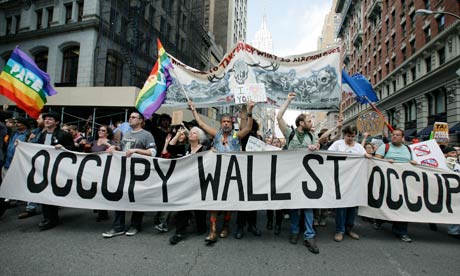
Occupy Wall Street--Year One


(Yes, Margaret, There is An Alternative)
I’d like to start with a confession. When I first descended upon the Bowling Green statue in Lower Manhattan on the morning of Saturday September 17, 2011 to discover a handful of people doing yoga, I was not impressed. While my spirits were raised when a larger, but still small group of people marched from Bowling Green to Zuccotti Park I did not believe that we were on the cusp of a historic moment. I had been involved in activism since I was a high school sophomore and as a result have participated in more protests than I care to admit publicly. At the time the events of that day didn’t seem particularly special or memorable.
 
 Looking back a year later, never in my life have I been so glad to have been so wrong. Far from being just another protest, Occupy Wall Street is unquestionably among the most important social movements of the past decade (which truly is an accomplishment, because in spite of the media narrative of passivity the last decade saw sizable protests against the IMF and World Bank, the war in Iraq, racism, and for women’s and immigrants' rights). Occupy has captured the public imagination like no other protests since the 1960s.

As the one year anniversary approaches, the media narrative will most likely focus on what Occupy has accomplished. Perhaps the media will fixate on the fact that many of the encampments are gone (whether or not they will mention that these encampments were violently broken up by the police is another story). Of course, while no single individual speaks for Occupy, it doesn’t take much to realize that Occupy’s victories lie not only in the encampments. They lie in the newly mobilized activist networks that have waged (and even won) battles in their own communities--whether it be the many homes defended against foreclosure or Occupy Baltimore’s campaign against a proposed new youth jail.

Just as important as these victories is the impact Occupy Wall Street has had in shifting the dialogue concerning economic issues. For decades, the spectrum of acceptable discourse has been rapidly closing. At the beginning of the 20th century there was a vigorous debate about how humans might organize their society. Socialists, anarchists, syndicalists, and radicals of every stripe attracted sizable audiences. Even relatively mainstream intellectuals like John Dewey expressed dissatisfaction with the wage economy and proposed that true democracy meant not just popular participation at the ballot box, but in the workplace as well. In short, capitalism and democracy were not one in the same, but were instead deeply antithetical to each other. 

Yet only eighty-some years later Margret Thatcher, one of the architects of the current neoliberal economic order, would chastise the people that there was “no alternative” to her particular brand of capitalist economics. What happened?  First, we were told that there was no alternative to capitalism. Then, not only did we have to accept capitalism as the only viable economic system, but we could only choose a particular brand of capitalism: A deregulated, cutthroat brand of capitalism that mixes unchecked corporate power with a disempowered working class, free markets with accelerated rates of incarceration and police repression, tyrannical technocrats with diminished formal representative institutions, corporate welfare with gutted social services, and in times of crisis, bank bailouts with austerity.

There was no alternative. And every politician accepted it. If you lived in the United States it didn’t matter if you elected Democrats or Republicans, the policies were essentially the same (as were the corporate donors). Western Europe, where social democratic and socialist parties still existed in name, faced a similar closing of discourse. 

Anthropologist David Graeber got it right when he said that Occupy was about the rediscovery of “the radical imagination.” While Occupy's coalition of supporters include everyone from left-leaning Keynesians to anarchists, Occupy’s power and appeal rests in its fundamental core assertion than there is indeed an alternative. It is the rejection that private profit is the only valid raison d'etre for anything, whether it be education and healthcare or prisons and the military. Instead, Occupy proposes the radical alternative that the lives, well-being, and futures of flesh and blood humans are too precious to be traded along with slips of paper on the floor of the New York Stock Exchange.

Saturday, September 1, 2012

The Hypocrisy of Mitt Romney


Even though Clint Eastwood’s bizarre and rambling monologue (which managed to upstage Romney) contained a vague anti-war statement and the implication that Romney would bring all US troops home from Afghanistan “tomorrow” (in actuality his platform calls for a withdrawal by 2014) Romney minced no words in his nomination speech about his foreign policy. While most of the foreign policy parts of his speech were nonsensical misstatements of Obama’s foreign policy (misstatements because Obama has been just as diligent in maintaing the American Empire as any of his predecessors) one point seemed particularly hypocritical for Romney.

Romney who repeated the absurd claim that Obama had been on an “apology tour” for the United States boldly claimed that America does not “dictate” to the world, but instead has “freed the world of dictators.” On face value this claim is almost too laughable to debunk. Between the long list of democratic governments deposed by the United States, the even longer list of dictators it has backed, and the realities faced by civilians in countries subject to US intervention it’s hard to even know where to start with the falsity of Romney’s claim.

However what makes Romney’s remark worth noting is the blatant level of hypocrisy inherent to this remark being made by Romney. The Huffington Post recently reported that Romney’s venture capital firm, Bain Capital, started by receiving money from individuals connected to Salvadorian death squads. 

During the Salvadorian Civil War over 75,000 civilians were killed, 85% percent of them killed by the US-backed government. Particular low points of the war were the murder and rape of four American nuns, the assassination of Archbishop Oscar Romero while giving mass, and the massacring of 900 citizens in the village of El Mozote. All crimes committed by death squads with close links to the government.

As if Romney’s business ties with Salvadorian death squads were not enough Truthout recently revealed that he was not the only person on the Republican ticket with ties to atrocities in the region. Vice Presidential nominee Paul Ryan has been receiving advise on foreign policy from Elliot Abrams. Abrams, who was convicted of two misdemeanor counts for his involvement in the Iran-Contra Affair, has a long history of supporting atrocities committed in Central America, including denying the El Mozote massacre--a tragedy confirmed by not only the New York Times and the Washington Post, but the United Nations Truth Commission and eventually recognized by the government of El Salvador itself. Abrams was also a noted supporter of the Contras, a rightwing group supported by the CIA that sought to overthrow the Sandinista government of Nicaragua. The International Court of Justice (ICJ) would find that CIA operations with the Contras, which included mining the harbors of Nicaragua, constituted an act of aggression. This ruling made the United States the only country ever found guilty of aggression by the ICJ. In addition to the ICJ’s finding Human Rights Watch’s predecessor organization concluded that Contras deliberately targeted civilian health care workers, and routinely engaged in rape, torture, and kidnapping. 

While the United States has never been a “Good Neighbor” to Central America the period in the late-1970s to early 1990s is one of the darkest in US-Central American relationships. During this time the US sought to suppress popular movements against oligarchical dictatorships and overthrow them when they succeeded (like the Sandinistas did in Nicaragua). To do so they supported brutal death squads and terrorist groups like the Contras.  For Romney, given Bain Capital’s ties to this dark chapter in American history, to speak of America “freeing the world of dictators,” shows a particular level of hypocrisy.  

Wednesday, August 29, 2012

Counterpunch

In the last month two of my articles initially posted here have found there way into Counterpunch. Some of you may even be visiting this blog for the first time after having read my writings on Counterpunch.

I am writing about this not congradulate myself, but to take a moment to thank everyone who has read, supported, and encouraged me in writing this blog.

In particular I would like to thank Alyssa Goldstein, Steven Trans-Creque, and Kevin Zeese for encouraging me to not only continue this blog, but to submit my first article to Counterpunch.

I would also like to thank the longtime readers of this blog, as well as welcome any new ones to this site.